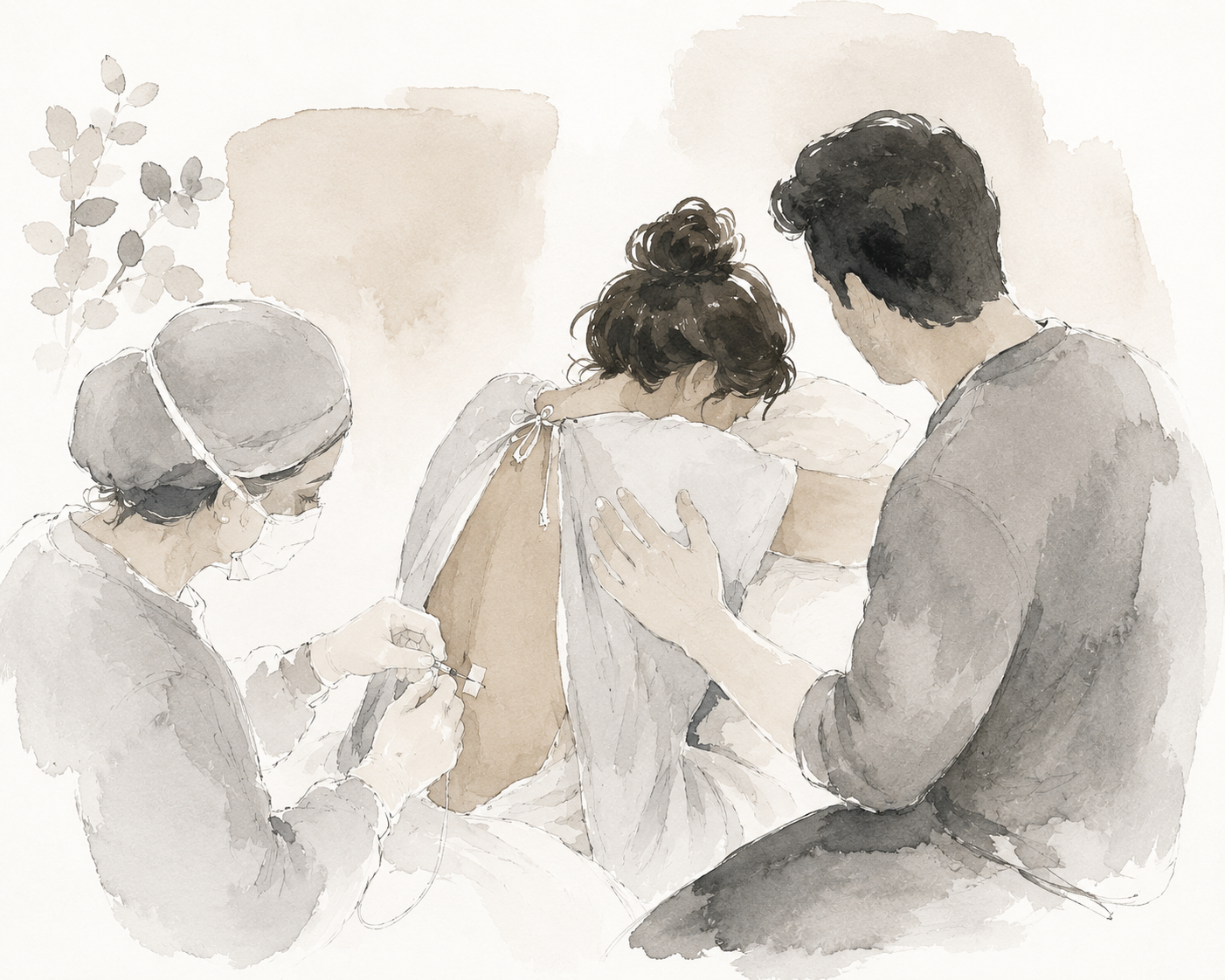
It’s one of the biggest fears I hear, fueled by stories that often leave out key context. So let’s answer the real question- “Will getting an epidural slow down my labor?”- and what they does that actually look like in a modern hospital in 2026.
First, let’s clear something up.
At Balance Birth, we aren’t “Team Epidural”
We’re also not Team “You Shouldn’t Get One.”
We’re Team “Know Your Options”
I’ve supported families who planned an unmedicated birth and absolutely loved it.
I’ve also supported families who walked into the hospital saying, “Please give me the epidural the second I’m admitted.”
I’ve watched parents change their minds halfway through labor.
I’ve watched others stick to their original plan.
None of those births were “better” than the others.
Because birth isn’t a competition.
It’s not an endurance event where the person who experiences the most pain gets a gold medal at the end. The goal isn’t to prove how tough you are. The goal is to have a safe birth where you feel informed, supported, and like your decisions were truly your own.
So why is it floating around that getting an epidural will stall your labor?
Nope, if you’ve worked with me as your doula you’ve heard me say “once you get that epidural I’m going to turn you like a rotisserie chicken!”
People picture getting an epidural and immediately imagine being strapped flat to a hospital bed. That just isn’t what I see in real life. Birthing moms are still rolling from side to side, sitting upright, using a peanut ball, changing positions every 20–30 minutes, and working with their nurse, partner, and doula to keep labor moving.
So while you won’t be strolling laps around the Labor & Delivery floor you will absolutely still be moving because epidural movement matters more than ever because changing positions helps create space in your pelvis, encourages your baby to rotate, and can make labor more efficient even after you’ve had an epidural.
Another surprise? You don’t have to even give birth flat on your back! I think movies have done us all a disservice here. I’ve helped clients push while lying on their side, on their hands and knees, and sitting up pulling against a squat bar.
Every labor is different and most nurses and doctors are happy to help you find positions that work well for both you and your baby.
Sometimes the best pushing position isn’t the one that looks the coolest in birth photos. It’s the one that helps your baby be born.
I often get asked “But doesn’t an epidural slow labor down?”
Here’s my favorite answer:
Sometimes, yes. But… not by much. Sometimes it actually does the exact opposite! In the birth worker community we call it a “therapeutic epidural” when someone has been laboring for hours or days and is staying at, say, 5 centimeters.
They’re exhausted. Every contraction makes their whole body tighten. They’re shaking. They’re running on almost no sleep. Honestly, they’re miserable.
Then they get an epidural and take the first deep breath they’ve taken in hours.
They close their eyes.
Their shoulders relax.
Their pelvic floor relaxes.
They nap for 45 minutes.
And suddenly…
They’re nine centimeters.
Or complete.
I’ve seen that happen more times than I can count. In fact, maybe I should start keeping count!
Does that mean epidurals always speed labor up?
Of course not.
But it does illustrate something really important:
Your body labors best when it feels safe.
Pain is a normal part of labor, but if the pain is causing your body to fight every contraction instead of working with it, effective pain relief can sometimes help labor become more efficient.
That’s why the old blanket statement that “epidurals slow labor” just isn’t accurate anymore.
For many families, the opposite ends up being true. Let’s get into the nitty gritty for a moment.
A study published in 2017 of a randomized controlled trial published in Obstetrics and Gynecology evaluated whether continuing epidural medication during the pushing stage affected delivery outcomes. Researchers found no increase in operative vaginal delivery or a substantially prolonged second stage of labor compared with women whose epidural medication was stopped.
However, a 2014 Cochrene Systematic review that involved more than 11,000 births found that epidurals did lengthen the pushing stage… by about 15 minutes on average and that modern epidural techniques did not appear to increase the risk of cesarean birth.
For many parents?
Absolutely.
Not because everyone needs one.
Not because they’re the “easy way out.” (Can we retire that phrase forever?)
But because sometimes the best decision is the one that helps you rest, breathe, regroup, and actually enjoy meeting your baby.
Birth doesn’t have to look one particular way to be beautiful and you don’t get extra points for suffering and you don’t lose points for asking for pain relief.
You simply deserve to understand your options before you’re making decisions in the middle of one of the biggest days of your life.
And that’s exactly why we teach what we teach.
Not to tell you what to choose… to help you understand what your options are and why you might choose it.

— Emily H.
References:
Anim-Somuah M, Smyth RMD, Cyna AM, Cuthbert A. Epidural versus non-epidural or no analgesia for pain management in labour. Cochrane Database of Systematic Reviews. 2018;(5):CD000331. doi:10.1002/14651858.CD000331.pub4.
Shen X, Li Y, Xu S, Wang N, Fan S, Qin X, Zhou C, Hess PE. Epidural Analgesia During the Second Stage of Labor: A Randomized Controlled Trial. Obstet Gynecol. 2017 Nov;130(5):1097-1103. doi: 10.1097/AOG.0000000000002306. PMID: 29016499.